

Audit Support vs Audit Defense

If you're a real estate investor, you've likely heard the terms "audit support" and "audit defense" thrown around when discussing cost segregation. They sound similar, but here's the truth: they’re not the same thing. Confusing the two could leave you exposed when the IRS comes calling. With the IRS receiving nearly $80 billion in additional funding and hiring thousands of new agents, audit scrutiny on cost segregation studies has intensified significantly. The IRS has even updated its Audit Technique Guide specifically for cost segregation, giving agents a clear roadmap of what to look for. Cost segregation is a powerful tax strategy that accelerates depreciation on building components, but it also puts a target on your return. The question you should ask yourself isn't whether the IRS could audit you, it's whether you're prepared when they do. So let's cut through the marketing language and understand what these terms actually mean.
First, Let’s Define Each Concept
Here's the fundamental difference in plain English:
Audit Support
A reactive service where the firm provides you with the study documents so you can respond to IRS questions.
You handle the IRS, with maybe a quick phone call to answer basic questions.
Surface-level involvement, as if they were saying: "Here's your report, good luck."
Ideal for routine documentation requests.
Audit Defense
An active, expert-led service where specialists engage directly with the IRS on your behalf.
The defense team handles the IRS. They manage all communications, data requests, and negotiations.
Deep engagement. Experts analyze IRS arguments, cite legal precedents, and push back on overreach.
Ideal for complex disputes, technical challenges, or aggressive IRS positions.
Audit support is essentially document delivery. A quality cost segregation study will always include thorough, audit-ready documentation with detailed engineering reports, cost breakdowns, photos, and clear methodologies that align with IRS expectations. This is the baseline that you should aim for in every report with any provider. This is why common requests from the IRS should be covered with Audit Support every time. If you have any doubts about the legitimacy of a cost segregation provider, please contact us and our team will be glad to help you out.
Audit defense, on the other hand, is active representation. When the IRS sends a notice challenging your classifications, a defense team doesn't just hand over the file. They understand the tax code, know the weak arguments the IRS often makes, and have experience pushing back. They turn a one-sided inquiry into a balanced discussion. If you have the time to ensure that your provider offers this, you’ll be able to trust their results a little more than their competition’s. At USTAGI, for example, we offer audit defense to every customer, precisely because we have the professionals and the experience to back up each one of our studies.
Why This Distinction Could Cost You Thousands
Here's a scenario that plays out more often than you'd think: An investor uses a discount cost segregation firm that promises "full audit support." Two years later, the IRS questions the reclassification of exterior lighting or kitchen cabinets. The investor calls their cost seg firm for help, but since that firm only offers "support", their answer might be something like this: "We've provided your report. You'll need to work with your CPA or respond directly to the IRS. We can answer basic questions but don't represent taxpayers in audits."
Suddenly, you're facing an IRS auditor alone, trying to explain technical depreciation arguments you barely understand. In one Tax Court case (AmeriSouth XXXII, Ltd. v. Commissioner), a cost segregation study was so poorly documented (lacking proper site visit evidence and containing overly aggressive classifications) that the taxpayer lost by default. The court mocked the taxpayer's position, and what should have been defensible deductions were completely disallowed. In another case (La Petite Academie v. Commissioner), the IRS successfully challenged asset classifications partly because the taxpayer's facts were "not properly developed, documented, or represented". Both sides got it wrong, but the taxpayer paid the price.
True audit defense means having experts who:
Know the weak spots in IRS arguments. For example, some IRS auditors still cite the AmeriSouth case to challenge cost segregation studies, even though that case was a procedural mess where the taxpayer stopped participating. A knowledgeable defense team knows to request the IRS's supporting rationale and cite stronger precedents (like Whiteco, Illinois Cereal Mills, or Piggly Wiggly when applicable) that support the taxpayer's position.
Push back on overreach. In software licensing audits, defense experts routinely reject auditor requests that exceed their legal rights, preventing "scope creep" and unjustified claims. The same principle applies to tax audits.
Handle technical complexities. Pass-through entities (S-corps, partnerships, LLCs) face unique challenges because depreciation flows through to individual owners. A defense team coordinates with your CPA to ensure owner-level tax positions are protected.
Questions to Ask Before Hiring
Before you commission a cost segregation study, ask these specific questions:
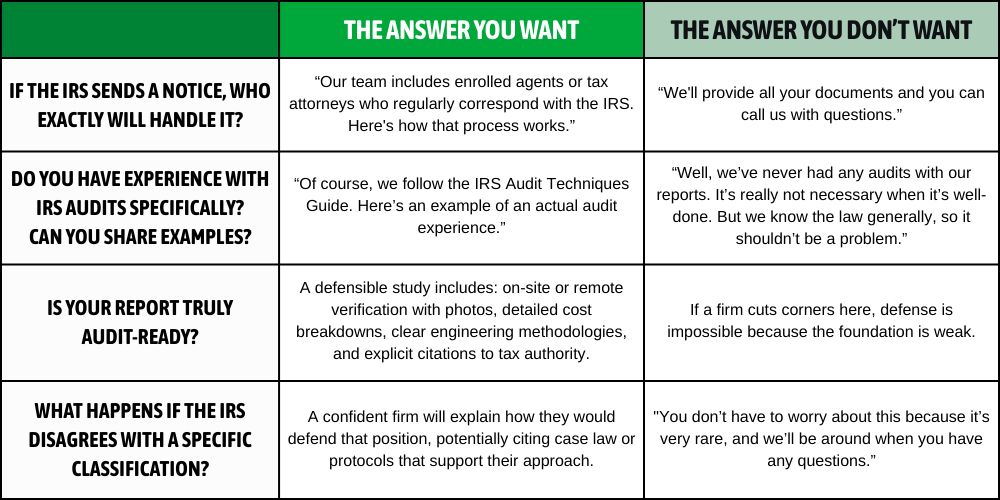
This image presents a comparison table designed to help tax professionals or business owners evaluate the quality and reliability of a Cost Segregation or Engineering-Based Tax Firm. It contrasts ideal, confident responses with vague or concerning answers to critical questions about IRS defense, audit experience, and report readiness.
Audit support gives you the tools. Audit defense gives you the warrior. But in every case, a quality cost segregation study is essential, and it should always include robust, audit-ready documentation. If you're maximizing depreciation you're making a significant tax bet with big ROI potential. Don't bet more than you're willing to defend. Hire a cost segregation firm that offers genuine audit defense, not just support.